
Why Growing Organisations Need More Than Good Intentions To Preserve Culture
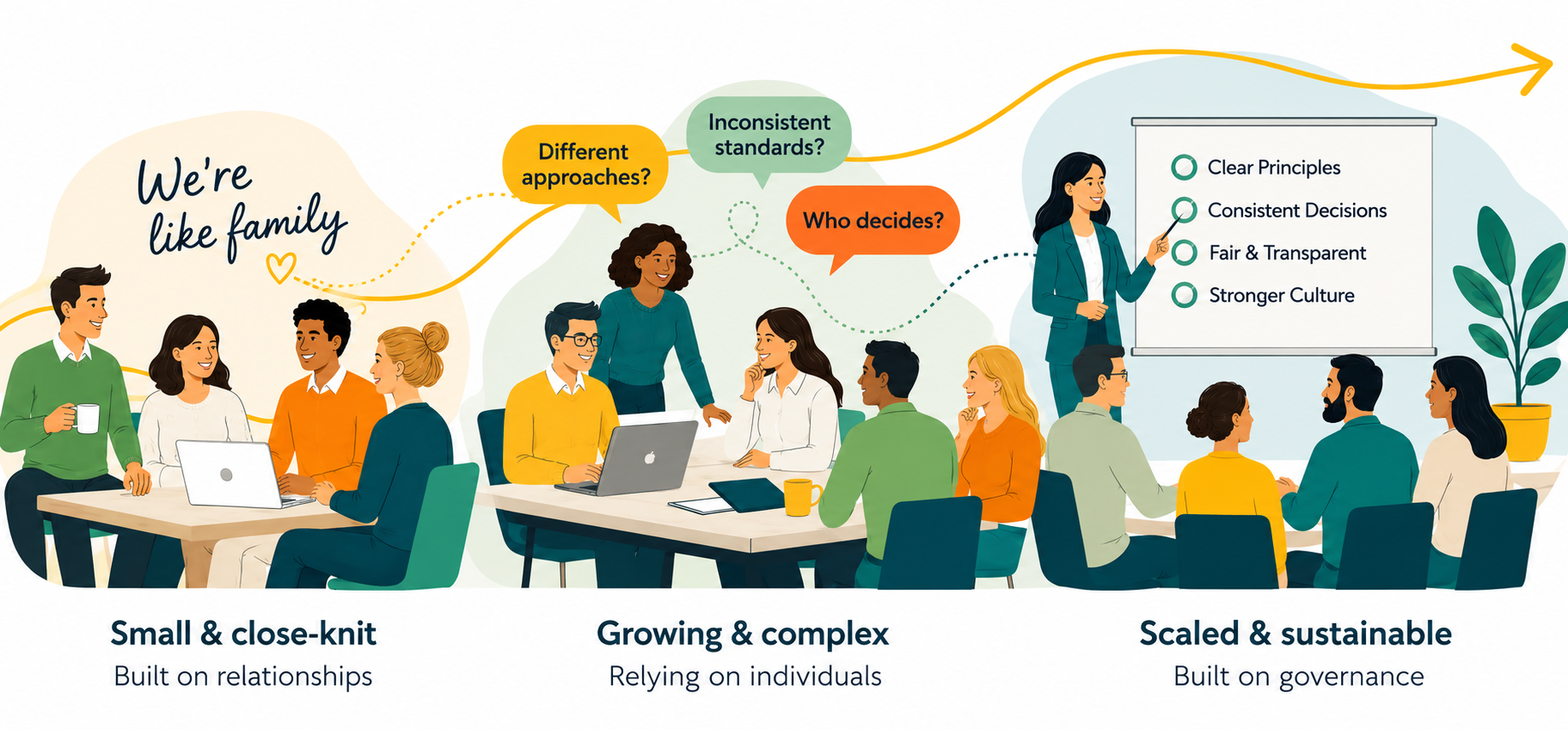
“We’re like family here.”
It’s a phrase that many organisations wear as a badge of honour. It reflects a workplace where people care about one another, leaders know their employees personally, and decisions are often made through trust rather than bureaucracy. For many small and growing businesses, this sense of belonging is one of their greatest strengths. It creates loyalty, encourages collaboration, and fosters an environment where people genuinely enjoy coming to work.
In the early stages of an organisation, this way of operating often works remarkably well. Teams are small, communication is informal, and everyone shares the same understanding of how decisions are made. Culture develops naturally through daily interactions rather than formal processes.
The challenge is that organisations don’t stay small forever. As businesses grow, they don’t simply add more employees; they add complexity. New managers are appointed, teams become larger, decision-making becomes distributed, and leaders can no longer be personally involved in every people decision. The relationships that once created consistency become harder to maintain, and organisations begin relying on individual judgement where shared principles are needed.
This is where the phrase “we’re like family” can unintentionally become a governance risk.
The problem isn’t caring for employees like family. The problem arises when organisations continue operating like a family long after they’ve become complex businesses. At that point, relationships alone can no longer guarantee fairness, consistency or accountability. Without intentional governance, organisations risk creating inconsistent employee experiences, exposing themselves to unnecessary people risk, and gradually weakening the very culture they are trying to protect.
Why the Family Mindset Works
The family mindset develops naturally in entrepreneurial organisations because it reflects how those organisations operate.
Founders know every employee personally. Communication happens informally, decisions are made quickly, and problems are often resolved through conversation rather than process. Employees understand the reasoning behind decisions because they are part of the same discussions, and trust develops through close working relationships.
This creates several genuine advantages. Organisations can respond quickly to change, leaders have a deep understanding of individual circumstances, and employees often experience a strong sense of belonging. In many cases, formal HR processes feel unnecessary because consistency is created through proximity rather than policy.
These characteristics should not be dismissed. They are often the very qualities that enable young organisations to grow successfully.
The challenge is recognising that the mechanisms which create consistency in a business of twenty employees are not the same mechanisms that sustain consistency in a business of two hundred.
When Relationships Replace Governance
Growth changes the way organisations operate. As leadership responsibilities become distributed across multiple managers, employees no longer experience the organisation primarily through the founder. Instead, they experience it through the decisions, behaviours and judgement of their immediate manager. This transition introduces a level of complexity that informal leadership cannot always accommodate.
Managers begin interpreting expectations differently. Flexible working arrangements are approved in one department but declined in another. Performance conversations vary in quality and frequency. Promotion decisions become increasingly difficult to explain, and disciplinary matters are approached inconsistently depending on who is leading the conversation.
None of these situations necessarily occur because leaders have poor intentions. They occur because relationships have become the organisation’s primary operating system.
When organisations rely on personal judgement instead of shared organisational principles, consistency becomes increasingly difficult to achieve. Employees begin asking questions such as:

These are often interpreted as employee relations concerns. In reality, they are governance concerns.
The Hidden Cost of Informality
One of the greatest misconceptions about governance is that it exists primarily to satisfy legal or compliance requirements. While governance certainly supports compliance, its broader purpose is to create consistency in organisational decision-making.
Without clear governance, organisations often experience challenges such as:
- inconsistent leadership decisions across teams;
- differing performance expectations between managers;
- perceptions of favouritism or unfair treatment;
- increased employee relations disputes;
- greater legal and compliance exposure; and
- growing dependence on founders to resolve people issues.
Perhaps most importantly, organisations become vulnerable to inconsistency. Employees no longer experience one organisational culture; they experience multiple cultures depending on who they report to. This is often the point where leaders begin saying, “Our culture isn’t what it used to be.” In reality, the organisation may still hold the same values. What has changed is the consistency with which those values are translated into everyday leadership decisions.
Governance Protects Culture
Governance is often viewed as the opposite of culture. In reality, effective governance is one of culture’s greatest protectors. Strong governance does not replace trust with bureaucracy. It provides leaders with shared principles that enable fair, transparent and consistent decision-making while still allowing room for professional judgement. As organisations grow, culture can no longer spread through proximity alone. It must be reinforced through leadership capability, clear organisational standards and consistent management practices.
When governance is designed well, employees understand what is expected of them, managers have confidence in how to respond to people challenges, and leadership decisions become easier to explain and defend. Rather than weakening culture, governance ensures that organisational values are experienced consistently across every team, every manager and every employee.
From Good Intentions to Organisational Maturity
One of the defining characteristics of organisational maturity is recognising that culture cannot depend solely on individual relationships. It must become embedded within the organisation itself.
This requires leaders to move beyond relying on unwritten expectations and towards building leadership capability, shared decision-making frameworks and consistent organisational practices.
At Yellow Seed, we often describe this as the point where organisations move from managing people through relationships to leading people through intentional systems. The objective is not to become more bureaucratic. The objective is to ensure that every employee experiences the same culture, regardless of who they report to. That is the difference between having a culture and being able to sustain one.
What This Means for Growing Organisations
Many leaders ask, “When do we need HR?” A more valuable question is: “Have our people practices evolved at the same pace as our organisation?”
This shifts the conversation away from introducing policies for the sake of compliance and towards building the organisational capability required for sustainable growth.
For many organisations, this is where strategic HR becomes invaluable.
Rather than acting as an administrative function, HR becomes the mechanism through which leadership capability, governance and culture evolve together. It provides the structure that enables managers to make consistent decisions, reduces unnecessary organisational risk, and ensures that culture continues to support business performance as the organisation grows.
The Conclusion...
The phrase “We’re like family” doesn’t have to disappear as organisations grow. However, it does need to evolve. Care, trust and belonging will always remain essential ingredients of a healthy workplace. Yet sustainable organisations recognise that relationships alone cannot support increasing complexity.
As businesses grow, governance becomes more than a compliance requirement. It becomes the mechanism through which culture is protected, leadership is strengthened, and fairness is experienced consistently across the organisation.
Ultimately, the organisations that scale most successfully are not those that choose between culture and governance. They understand that the two are inseparable. Culture creates belonging. Governance creates consistency. Together, they create organisations that people trust, leaders can confidently lead, and businesses can sustainably grow.
How Yellow Seed Helps
At Yellow Seed, we partner with growing organisations to build the leadership capability, governance frameworks and people systems that enable culture to scale alongside the business.
Whether through HR as a Service, leadership development or organisational diagnostics, our focus is helping organisations strengthen both performance and culture. We work alongside leaders to establish consistent management practices, reduce organisational risk, and create people systems that support sustainable growth without losing the culture that made the organisation successful in the first place.
Want to explore whether your people practices are keeping pace with your organisation’s growth? We’d love to start the conversation.
