
Think about the last talent initiative your organisation launched. It may have been a new leadership framework, performance approach, succession process, set of organisational values or career architecture. The strategy was sound. The framework was carefully designed. Leaders were briefed, managers were trained, and the launch communication went out on time.
And yet, several months later, much of the organisation was still working exactly as it had before.
This is the uncomfortable reality of talent transformation: a well-designed practice is only the beginning. Its value is realised when it starts to shape the everyday decisions, conversations and routines through which people experience work.
That distinction matters because understanding a process is not the same as being willing and able to use it. Gartner reported in 2025 that only 32% of mid-to-senior business leaders said the last change they led achieved healthy employee adoption. Even when the case for change is compelling, the distance between intention and sustained behaviour can be considerable.
Why talent strategies struggle to become embedded
Most organisations concentrate their implementation effort in three places: designing the framework, communicating the process and training managers. All three matter. But in our experience, they do not, on their own, change what happens on a busy Tuesday morning when a manager has limited time, competing priorities and a difficult people decision to make.
People are not resisting simply because they have failed to understand the message. They may be protecting a familiar way of working, uncertain about what good looks like, worried about getting it wrong or responding rationally to systems that still reward the old behaviour. Embedding therefore has to be designed around the human experience of change – not only around the communication plan.
How Yellow Seed approaches embedding differently
Traditional change frameworks have made an important contribution to how organisations plan and lead change. They help us think about sponsorship, communication, readiness and the broader journey from a current state to a desired one. We use and value that thinking.
Our experience, however, has shown us that a sound change plan does not automatically translate into a changed experience for the person on the receiving end of it.
A manager may understand a new performance approach and still avoid the conversation when it feels uncomfortable. A leader may support a talent philosophy but fall back on familiar judgements when the decision carries risk. An employee may attend the launch of a career framework and still be unsure what it means for their own future. These responses are not evidence that people are simply resistant. They often tell us that the change has not yet become meaningful, safe or usable in the reality of work.
This is where Yellow Seed places its attention: not only on the change that needs to be managed, but on the experience through which people make sense of it and learn to act differently.
We work backwards from the behaviour the organisation hopes to see and the experience of the people being asked to adopt it. We consider what will make the change meaningful, what will capture people’s attention, how they will learn from one another, where they can practice safely and whether the surrounding environment supports what is being asked of them. These questions have shaped six principles that guide how we approach embedding change at Yellow Seed.
Six principles that shape how we embed change
Through our work, we have learned that people do not change simply because a new talent practice makes strategic sense. They need to understand why it matters, experience its relevance and feel supported enough to use it in their everyday work. This has led us to six interconnected principles that shape how we design change and learning experiences at Yellow Seed.
1. Create meaning before you create method
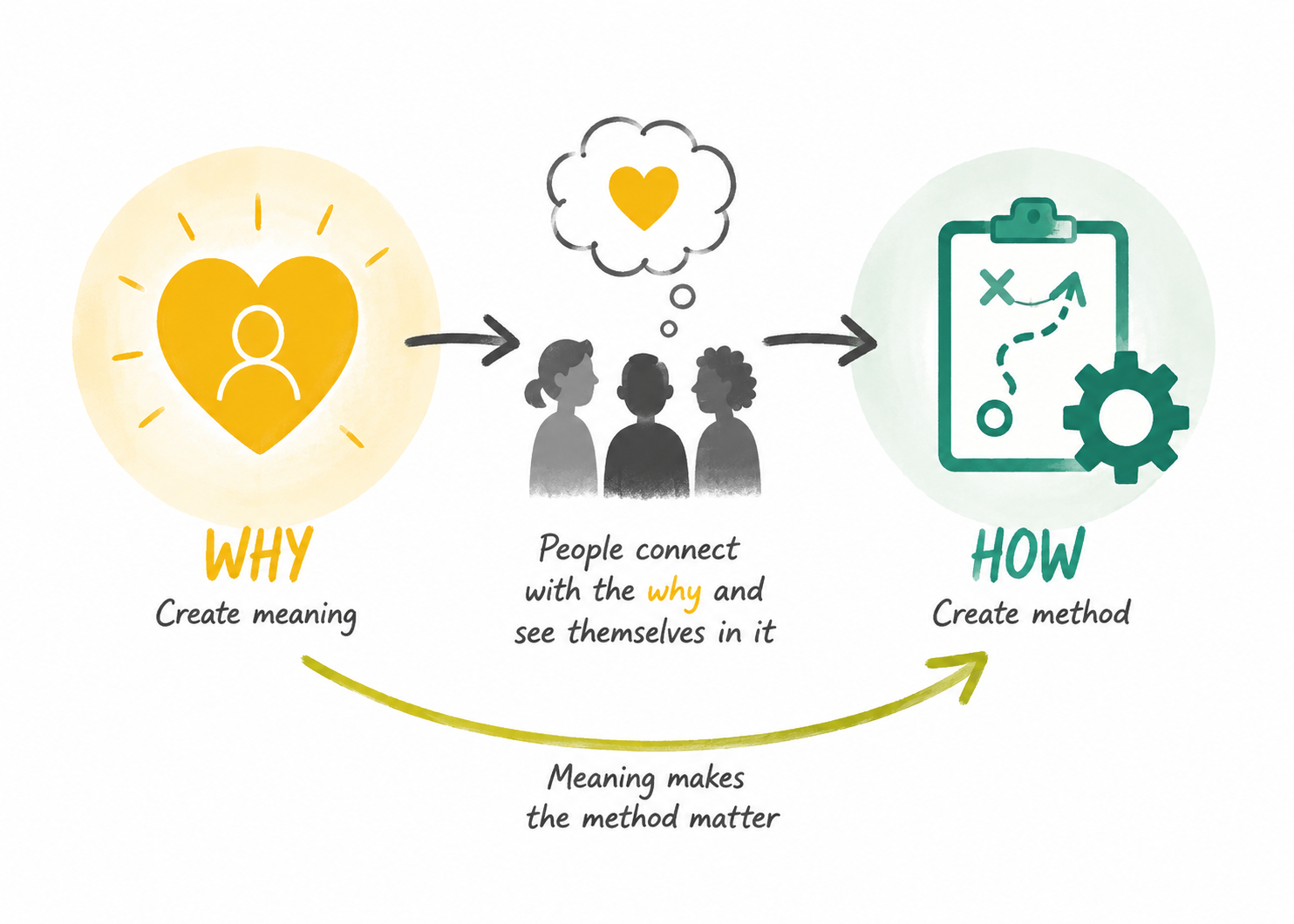
It is tempting to begin by explaining the new framework, process or tool. But before people are ready to engage in how something works, they first need to understand why it matters.
We therefore begin with the meaning behind the change: why it is needed, how it connects to people’s experience and what difference it could make for them. Instead of only asking, ‘What do people need to know?’, we also ask, ‘Why would they want to engage?’ When people can see themselves in the reason for the change, the method becomes easier to understand and far more relevant.
2. Design experiences, not presentations
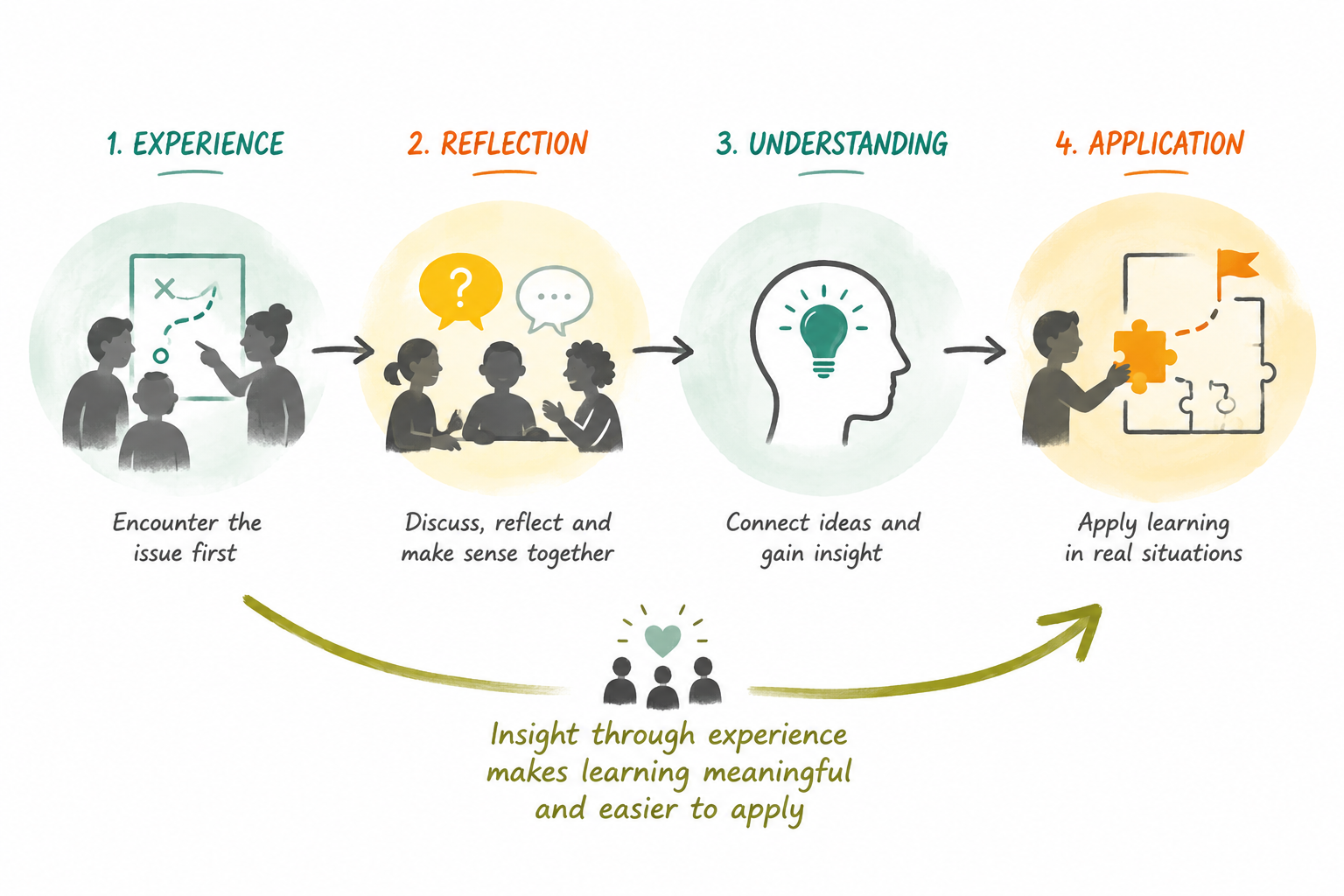
People rarely remember another set of slides. They are far more likely to remember something they experienced, discussed and worked through for themselves.
We design learning as a movement from experience to reflection, from reflection to understanding and from understanding to application. This may involve a simulation, a shared challenge, a case study or an activity that allows people to encounter the issue before being given the answer. The purpose is not engagement for its own sake. It is to help people arrive at insight through experience, making the learning more meaningful and easier to apply.
3. Emotion creates attention
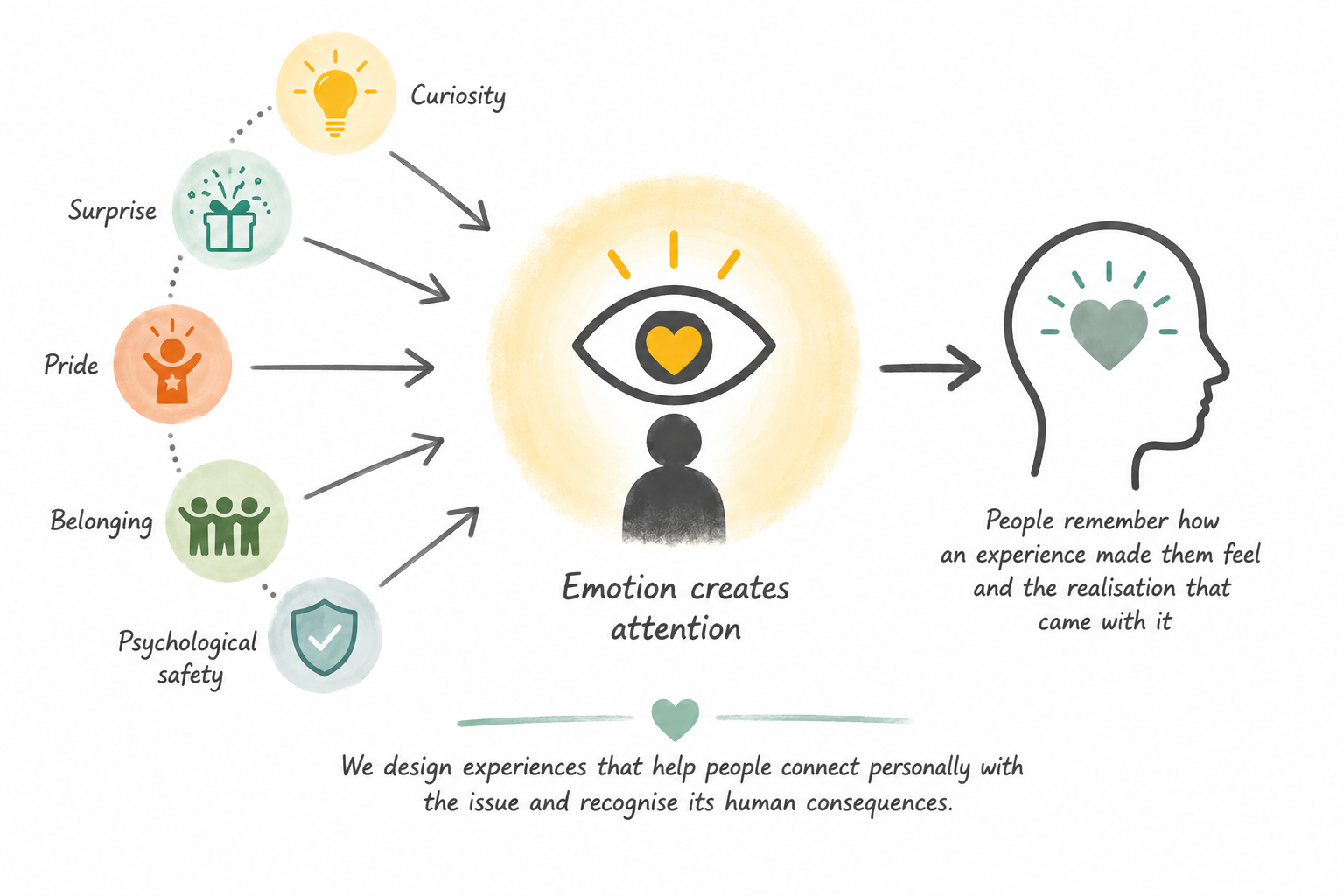
Emotionally meaningful experiences capture attention and are often remembered more effectively than neutral information. In practice, people are more likely to engage when an experience creates curiosity, surprise, pride, belonging or psychological safety.
We do not manufacture emotion or use it as theatre. We design experiences that help people connect personally with the issue and recognise its human consequences. People may not remember every model or slide, but they often remember how an experience made them feel, and the realisation that came with it.
4. Learning is social

People learn by watching others, discussing what they see, testing their thinking, receiving feedback and observing how colleagues respond.
For this reason, our experiences are not designed around the assumption that everyone simply needs to attend the same presentation. We ask who needs to be involved in creating shared understanding and reinforcing the new behaviour. This could include managers, employees, senior leaders or cross-functional colleagues. The question is not only, ‘Who needs to attend?’ It is, ‘Who needs to be involved for this way of working to become credible and sustainable?’
5. Practice builds confidence
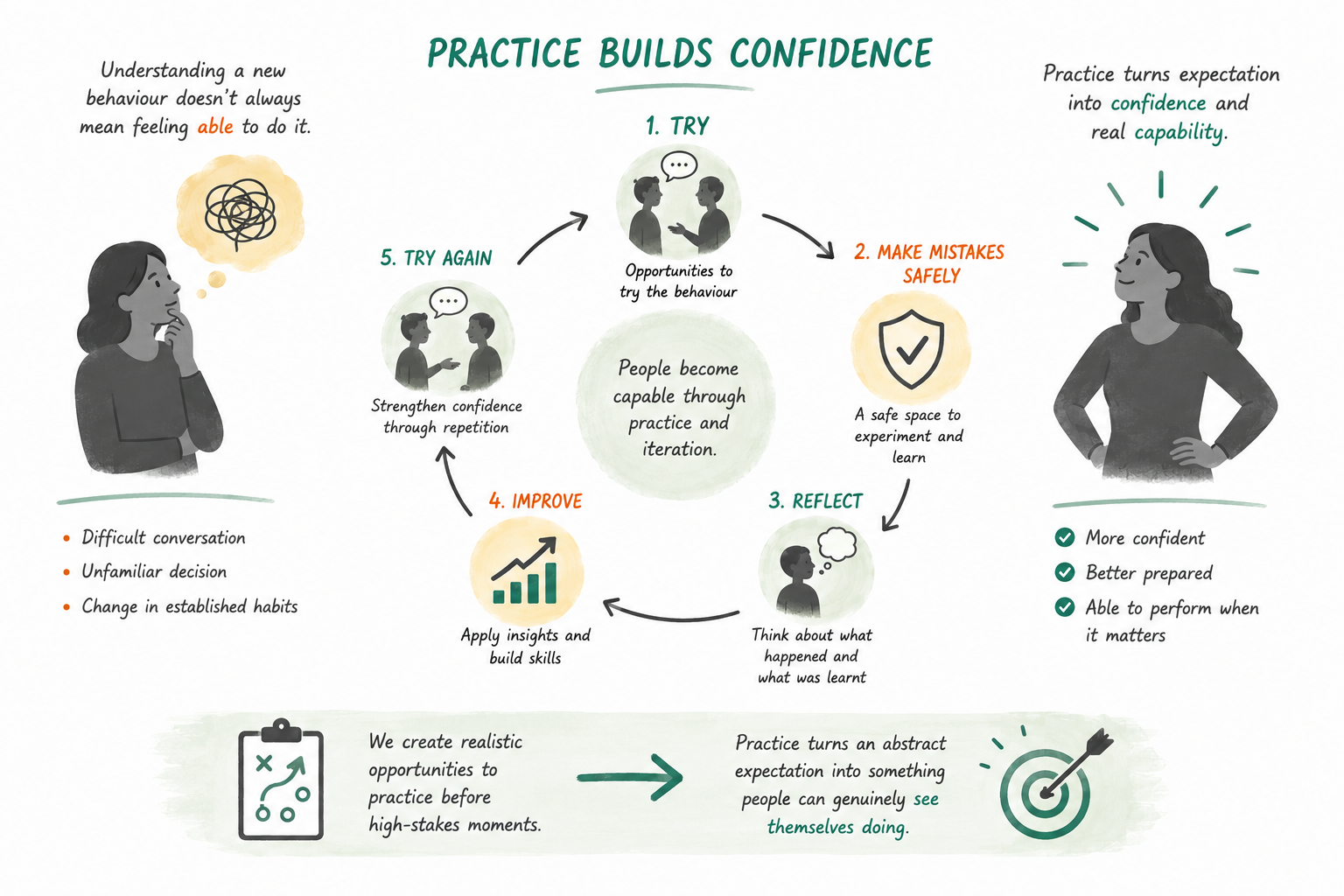
Understanding new behaviour does not automatically mean someone feels able to perform it, especially when it involves a difficult conversation, unfamiliar decision or change in established habits.
People become capable because they have opportunities to try, make mistakes safely, reflect, improve and try again. We therefore create realistic opportunities for people to practice the behaviour before they are expected to perform it in higher-stakes situations. Practice turns an abstract expectation into something people can genuinely see themselves doing.
6. Behaviour is designed by the environment
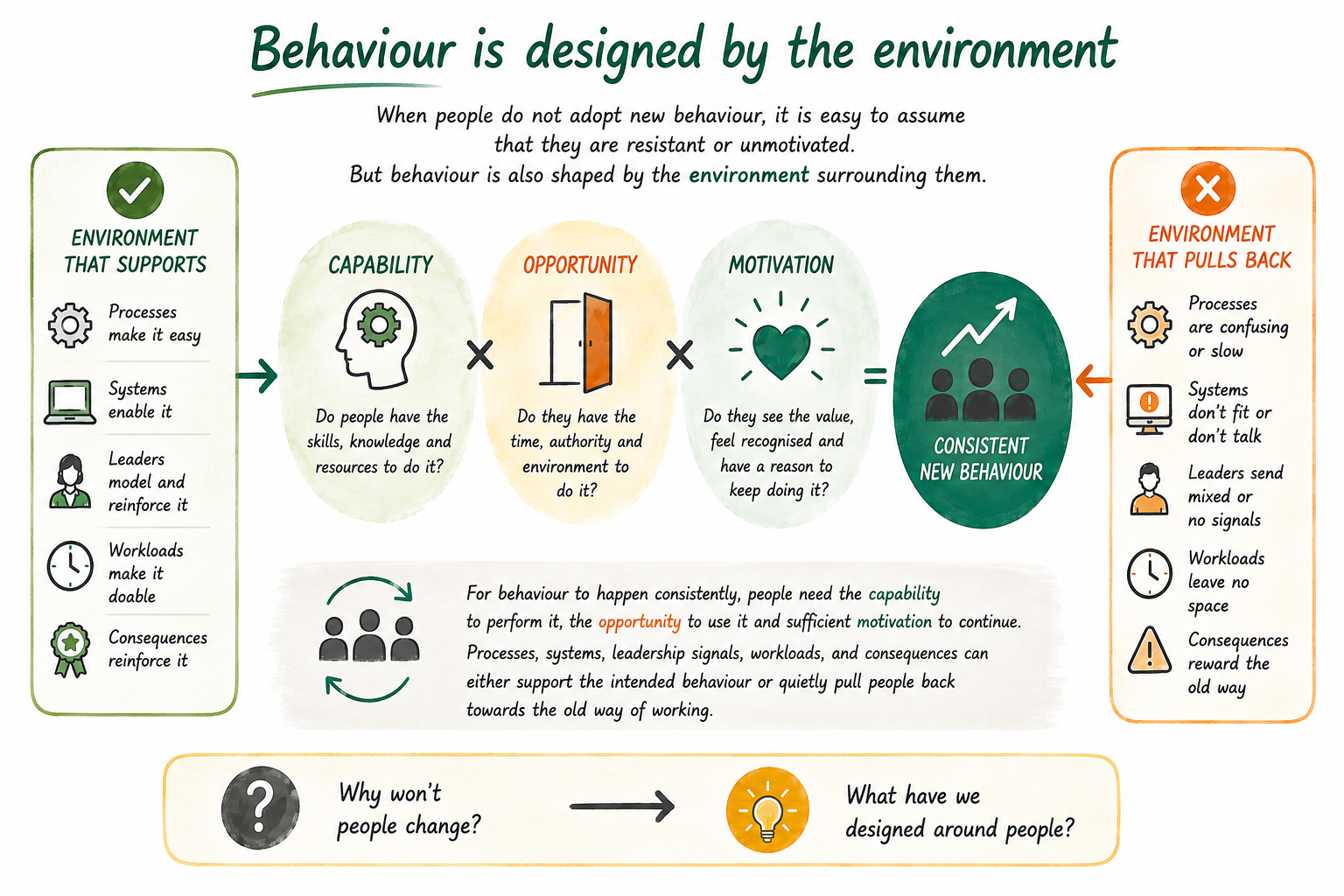
When people do not adopt new behaviour, it is easy to assume that they are resistant or unmotivated. But behaviour is also shaped by the environment surrounding them.
For behaviour to happen consistently, people need the capability to perform it, the opportunity to use it and sufficient motivation to continue. Processes, systems, leadership signals, workloads, and consequences can either support the intended behaviour or quietly pull people back towards the old way of working. We therefore ask, ‘What have we designed around people?’ rather than only, ‘Why won’t people change?’
From experience to embedded practice
These six principles do not replace traditional change frameworks. They sharpen the focus on human experience through which change becomes meaningful, learnable and usable. At Yellow Seed, we do not judge implementation by whether a talent practice has been communicated or launched. We look at whether people understand why it matters, have experienced what it requires, feel confident using it and work in an environment that supports the intended behaviour. Because the real test of a talent practice is not whether people have seen it. It is whether it changes what they do.
What this looks like in practice
In one leadership talent initiative we supported, the challenge was not that leaders lacked a definition of talent. The challenge was that talent was still experienced as an annual HR process rather than an everyday leadership responsibility. We therefore shifted the emphasis away from explaining talent and towards creating a shared experience. Leaders explored future potential, developed a common language, practised talent conversations and applied the thinking to their own teams. Success was not measured by attendance. It was visible in what leaders did differently after the session.
In another piece of work, executives needed to move from functional silos and escalation-based decisions towards clearer accountability and cross-functional ownership. Explaining the new operating model would not have been enough. The experience needed to help them confront the consequences of the current system, develop shared meaning and practice the decisions and conversations the new model required.
The activities were different because the contexts were different, but the design thinking remained consistent. We created meaning before introducing the method, designed an experience rather than another presentation, used the group as part of the learning, created opportunities to practice and considered what in the wider environment would either support or undermine the intended behaviour.
From a launched initiative to “how we work here”
Talent strategies do not fail only because people disagree with them. They often struggle because the organisation asks people to behave differently while the surrounding experience remains largely unchanged. The real work of embedding is to help people loosen old habits, practice new decisions and conversations, and receive enough support and reinforcement for those behaviours to endure.
So, when planning your next talent initiative, do not ask only, ‘What do people need to know?’ Ask what will make the change meaningful, what people need to experience and practice, who they need to learn alongside and whether the environment around them supports the behaviour being asked for. That is the shift from presenting a new talent practice to helping people genuinely work differently.
Ready to move your talent strategy into everyday practice?
Yellow Seed helps organisations translate talent frameworks, leadership practices and organisational change into experiences that build real capability and sustained behaviour. If your initiative is well designed but has not yet changed everyday practice, we can help you understand where it is getting stuck and design the conditions that will help it take root.
