
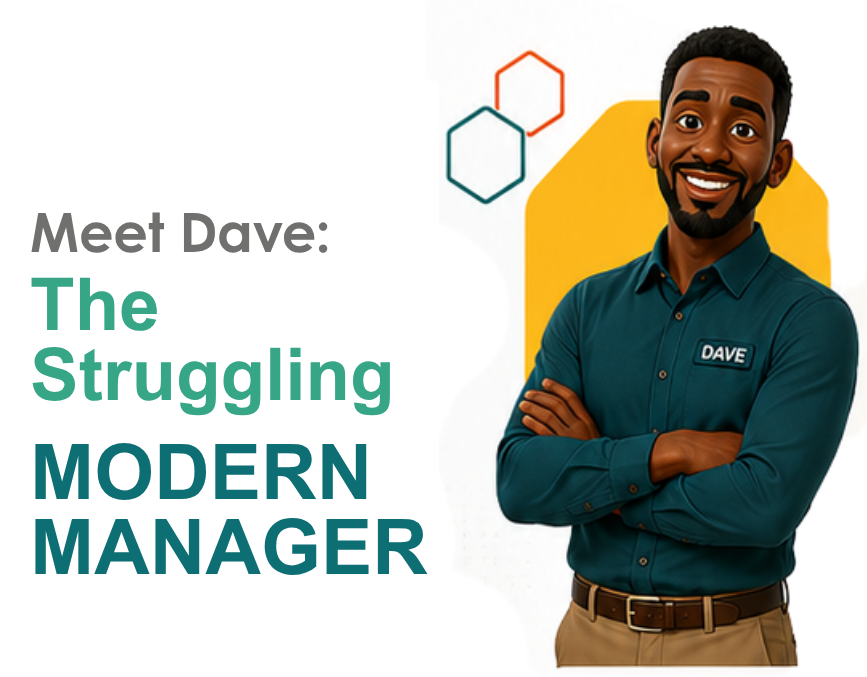
Dave was recently promoted to Sales Manager after being one of the strongest individual contributors in the business. He consistently exceeded targets, clients loved him, and leadership saw him as a future star. Promoting him felt like an obvious decision. Now Dave leads a team of six.
Overnight, his role has fundamentally changed. He is no longer responsible only for his own performance. He is now expected to drive performance through others, coach struggling team members, identify high-potential talent, make fair promotion decisions, build capability across the team, contribute to succession discussions, and keep his people engaged and motivated, all while still hitting his sales targets.
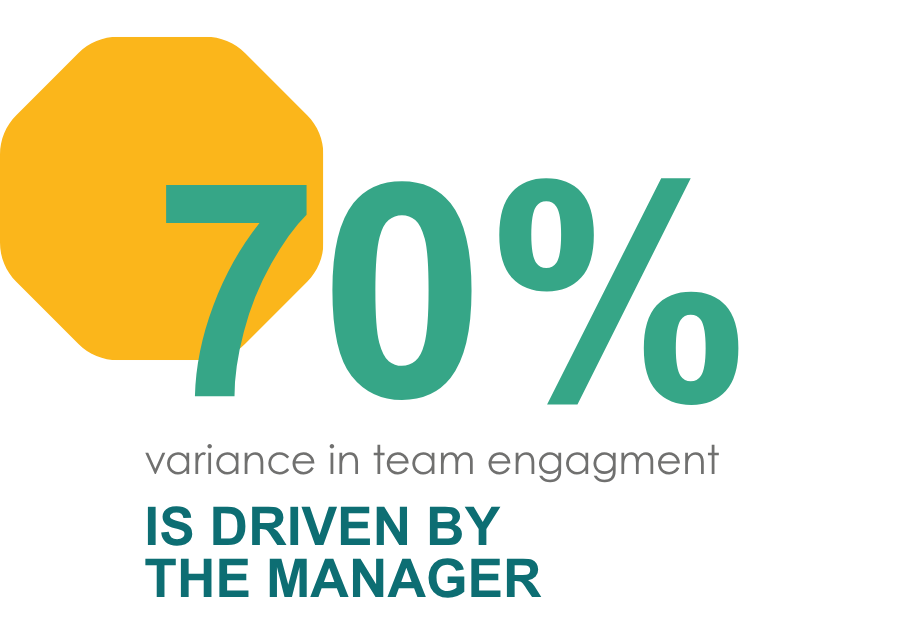
That matters more than many organisations realise, because for most employees, the manager is the company. Gallup suggests that as much as 70% of the variance in team engagement is driven by the manager. In practice, this means employees experience the organisation not through policies, values posters, or talent frameworks, but through the person they report to every day. Managers like Dave are the lens through which employees interpret culture, performance expectations, development opportunities, and what the organisation truly values.
This manager effect is not just theoretical. In Google’s well-known Project Oxygen, the company initially believed managers mattered less in a highly technical environment.
But after analysing performance and employee data, Google found the opposite: manager quality had a significant impact on employee performance, engagement, retention, and team effectiveness. The findings ultimately led Google to invest heavily in manager capability and define what great management looked like through evidence-based behaviours.
In today’s environment, organisations are no longer asking managers to simply supervise work, they are asking them to operate as Modern Managers: leaders who can simultaneously deliver results, develop talent, and shape employee experience.
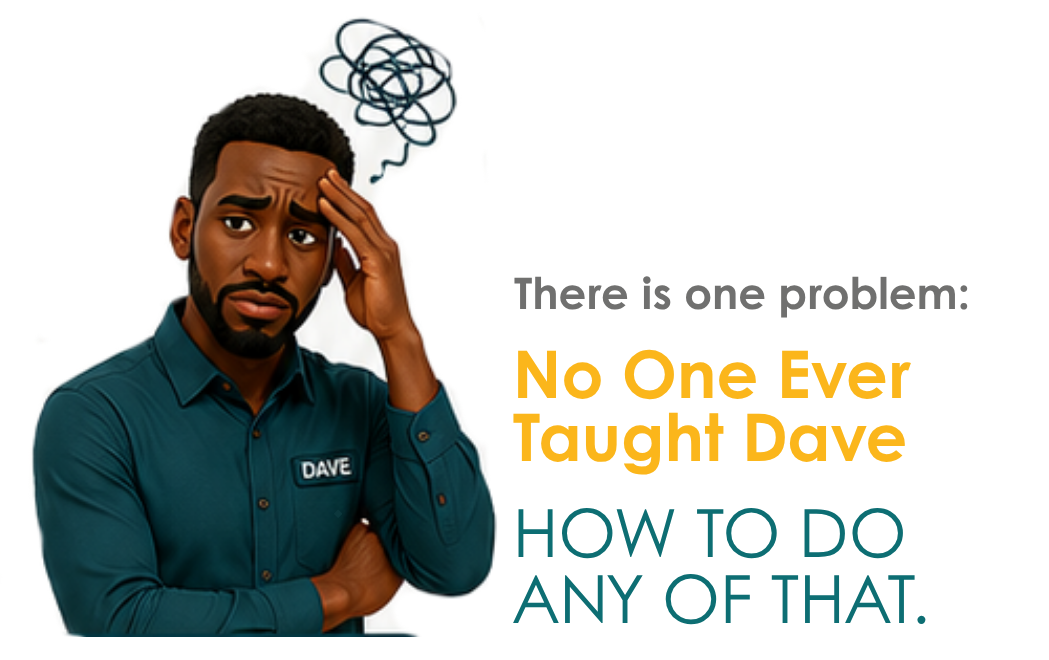
No one showed him how to assess potential objectively, hold developmental coaching conversations, differentiate performance fairly, identify bias in his decisions, or think strategically about succession. And Dave is not alone. Despite the increasingly critical role managers play, only 27% of managers globally report feeling engaged themselves. At the same time, 75% of HR leaders believe managers are overwhelmed by the expansion of their role, and 70% of managers say they have not received sufficient training to lead talent and development effectively.
In other words, we are asking the people who shape the employee experience most directly to perform one of the most complex roles in the organisation while they themselves are disengaged, overloaded, and underprepared.
So, Dave does what most managers do when they are handed responsibility without support:
He relies on instinct.
He gives stretch work to the people he trusts most.
He mistakes confidence for potential.
He rates people based on recency and gut feel.
He avoids difficult conversations until they become unavoidable.
He treats performance reviews as administrative exercises.
He leans on HR whenever things get uncomfortable.
And without realising it, Dave becomes the point at which the talent system breaks down.
The Real Problem Is Not the Talent Framework
Research consistently shows that line managers are the critical link between HR strategy and employee experience. Employees do not experience talent frameworks directly; they experience how their manager interprets and applies them. In practice, what a business intends through its talent strategy and what employees actually experience are often two very different things, and the manager is usually the reason for the gap.
It’s also important to consider the cost of getting this wrong. Gallup estimates that disengaged employees cost the global economy trillions annually in lost productivity, with poor management repeatedly identified as one of the strongest drivers of disengagement. In practice, this means ineffective people leadership is not only a culture issue, but a measurable business risk.
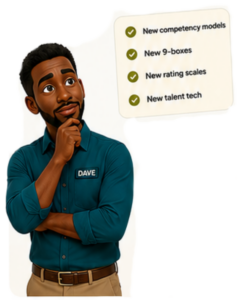
The strength of any talent strategy is ultimately determined not by the quality of the framework itself, but by the quality of the managers responsible for executing it. Yet when organisations notice poor talent outcomes, their instinct is often to redesign the process. They refresh the competency model. Tweak the 9-box. Adjust the rating scale. But the framework is rarely the real issue. Because even the best-designed talent process still depends on managers like Dave to execute it well.
As Hutchinson (2008) famously argued, designing HR policies without considering the line manager as the implementer is like designing a car without thinking about who is driving it.
What Research Tells Us Managers Need
Research by Bos-Nehles et al. (2013) into line manager effectiveness suggests that three conditions determine whether managers implement people practices effectively: they need the Opportunity to do it, the Motivation to prioritise it, and the Ability to execute it well. This is known as the AMO Framework.
Let’s break down what this means for Dave.

Opportunity: Does Dave Have the Space to Lead Talent?
Before Dave was promoted, he was expected to deliver ten major sales per month. After his promotion, he is still expected to deliver ten major sales per month-except now he must also lead six people, coach performance, develop talent, contribute to succession discussions, and manage engagement. So the obvious question becomes: When exactly is Dave supposed to do all of that?
Opportunity is about whether the organisation has created the practical conditions for people management to happen. Has Dave’s workload been adjusted to reflect his expanded responsibilities? Has his individual contributor target been reduced now that he is expected to lead through others? Are the systems around him simple and usable, or are they overly administrative? Does he have access to HR support when navigating complex people decisions?
Because if people management is simply added on top of Dave’s existing workload, it will always be deprioritised in favour of immediate operational demands.

Motivation: Is Dave Rewarded for Leading Talent?
Even if Dave has the time, he still needs a reason to prioritise people management. Managers focus on what the organisation signals matters. If Dave’s bonus, scorecard, and performance review are still based entirely on his sales performance, then the organisation has made its priorities clear: revenue comes first, people leadership comes second. And Dave will respond accordingly.
Motivation means ensuring the systems around Dave reinforce that people management is part of his role, not an optional extra. It means measuring and rewarding managers not only for what they deliver personally, but for how effectively they lead through others. This could include metrics related to engagement, retention, leadership effectiveness, succession readiness, or team development outcomes.
Because if Dave is only rewarded for hitting his sales target, then no amount of messaging about “people-first leadership” will change where his focus goes.

Ability: Does Dave Actually Know How to Lead Talent Well?
But even if Dave has the time and the incentive, there is still one critical question left: Does he actually know how to do it? Being a high performer does not automatically make Dave an effective Modern Manager. Being able to sell does not mean he knows how to coach others to sell. Being technically strong does not mean he knows how to assess potential objectively. Being commercially successful does not mean he knows how to differentiate between performance and readiness for promotion. Ability is about equipping Dave with the knowledge, skill, and confidence to lead talent effectively. Because if Dave has never been taught how to lead talent well, expecting him to do so consistently is unrealistic.
And this is where the research becomes particularly powerful:
Of the three AMO factors, ability appears to be the strongest predictor of effective implementation. More than motivation. More than opportunity. More than process design. In other words, if organisations want better talent outcomes, the single most powerful lever they can pull is building manager capability.
Additionally, research from Cargill’s manager coaching intervention found that targeted manager development improved leadership effectiveness and coaching quality, with downstream effects on employee engagement and performance. The finding reinforces this broader pattern in talent research: when managers are equipped with practical people leadership capability, team outcomes improve.
Building Capability Requires More Than Traditional Training
The challenge, however, is that recognising capability as the answer is not enough. Many organisations know managers need development, but still struggle to build that capability effectively in practice. The traditional answer has been leadership training: classroom workshops, theory-heavy modules, and generic leadership programmes designed to “upskill managers.” But the reality is that most of these interventions fall short. As Deloitte’s 2025 Human Capital Trends report emphasises, managers increasingly expect learning that is immersive, continuous, and embedded in work. Training can no longer be something managers attend; it must be something they experience. That’s where gamification comes in.
Consider Deloitte, which boosted leadership engagement with gamified dashboards, increasing weekly learner return visits by 37%. Cisco used levels and quizzes to drive 13,000+ completions in its social media training, while IBM’s digital badge program delivered a 226% rise in course completions. Marriott even used a gamified recruitment game to attract 25,000 applicants in the first week across 58 countries. The impact is clear: gamification works.
Research into learning transfer consistently suggests that traditional classroom training alone has a limited behavioural impact when learning is not reinforced through practice, feedback, and application. Studies on experiential learning repeatedly show stronger behavioural transfer when managers are given opportunities to practise decision-making in realistic environments rather than only learning concepts theoretically. Gartner data shows gamification can increase engagement in learning programmes by up to 60%. Why? Because it taps into our natural human drivers: competition, curiosity, achievement, and play (Jahri, 2025).
To put simply, managers do not become better talent leaders by hearing about coaching, feedback, or succession planning in a workshop. They become better by practising those skills, receiving feedback, and applying them repeatedly in realistic environments. Dave does not need another slide deck explaining why coaching matters. He needs to practise having difficult conversations. He needs to wrestle with difficult talent decisions. He needs to experience the ambiguity, trade-offs, and consequences of people leadership in environments that mirror the real world.
Before We Build Capability, We Must Define It
But before organisations can build manager capability effectively, there is an even more fundamental question to answer: What capability are we actually trying to build?
One of the biggest gaps we see in the market is that many organisations still lack a clear definition of what the Modern Manager capability set truly is. The manager role has changed dramatically. Modern managers are no longer just operational supervisors-they are expected to coach, develop, engage, assess, differentiate, and grow talent while delivering results. Yet many organisations are still building leaders against outdated competency models that do not reflect this new reality.
Before capability can be developed, it must first be clearly defined. At Yellow Seed, we believe one of the most pressing unanswered questions in talent today is this: What does great modern management actually look like? This is why we are currently developing a Modern Manager Capability Framework, designed to define the critical mindsets, skills, and behaviours managers now need to lead talent effectively in today’s environment. Watch this space.
Final Thought
Perhaps the biggest irony is this: managers are arguably the single biggest driver of employee experience, yet globally, manager capability remains one of the least intentionally developed organisational levers.
Dave is not the problem. Dave is the symptom. He represents thousands of managers who have been handed responsibility for talent without being equipped to succeed. Talent strategies do not fail because organisations lack frameworks. They fail because managers are expected to execute them without the capability, support, and system design required to do so effectively.
The organisations that will outperform in the future will not be those with the most sophisticated talent models on paper. They will be the ones who intentionally build Modern Managers. Because in the end, talent management is not an HR process. It is a Modern Manager capability.
